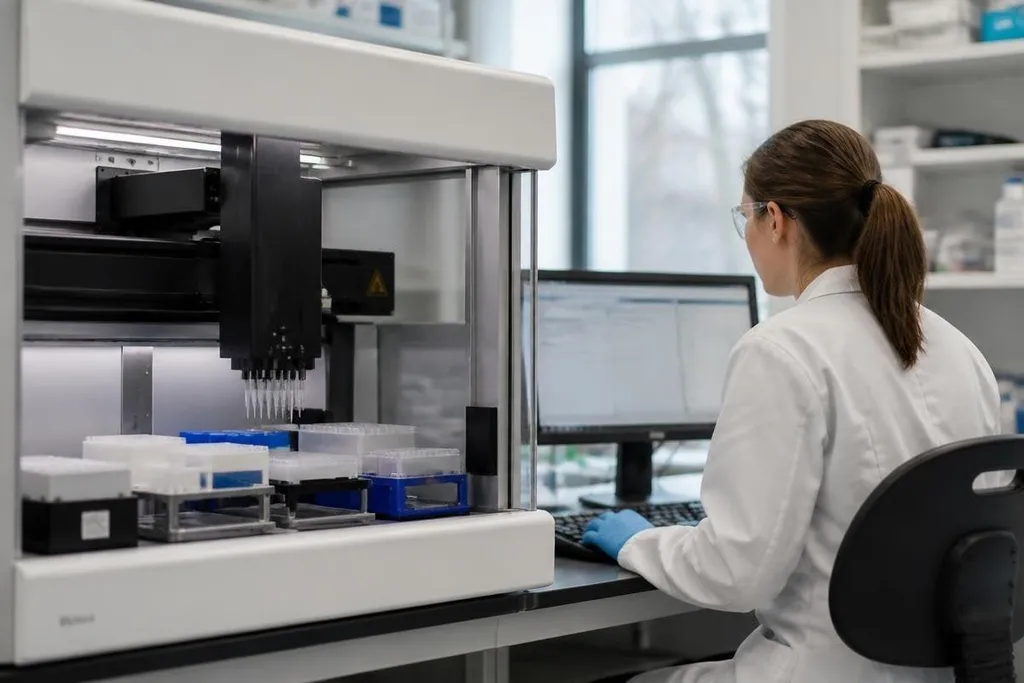
A laboratory robot can move liquid between wells, label samples, run timed steps, and record each action in software. That shifts scientists away from repeated hand work and toward planning experiments, checking results, and fixing failed methods.
For a lab deciding where automation fits, the useful question is not whether a robot looks advanced. It is which task can run the same way each time, with less risk of missed steps.
- Robots handle repeated pipetting, mixing, and sample transfers.
- Software records task settings and links them to each result.
- Scientists still set the method, check data, and handle unusual samples.
Repetition moves from hands to software
Many lab tasks follow a fixed sequence. A sample is measured, moved into a tube or plate, mixed with another liquid, and left for a set time. A robot can repeat that sequence with the same programmed settings across many samples.
This matters when small handling differences can change the result. A human may hold a pipette at a different angle or pause for a different length of time. A robot can keep the same motion, volume, and order until the method changes.
The machine does not remove the need for a trained scientist. Someone still chooses the liquid-handling method, checks that the robot dispenses the needed volume, and decides whether the result makes sense.
Software becomes part of the experiment
A laboratory robot is tied to software that controls movement, timing, tools, and sample locations. That record can make it easier to repeat an experiment or find the step where a run went wrong.
The benefit grows when the robot connects with instruments such as plate readers, liquid handlers, or imaging systems. A result can move from one stage to the next without a person copying every value by hand.
That setup also creates a new failure point. A wrong sample map, missing labware setting, or bad calibration can affect an entire run. The robot may perform the programmed task correctly while the program itself is wrong.
A lab automation report needs the sample type, robot model, run date, and human checks beside its result. A dated report from Robot24 can put those facts next to the machine’s task, so you can tell whether it changed the research workflow or only repeated a narrow step.
Where laboratory robots help most
Automation fits best when a method has clear steps and many repeated samples. It can also help when the work involves conditions that are tiring, unpleasant, or hard to keep steady by hand.
Common uses include liquid handling, sample preparation, plate filling, timed incubation steps, and repeated imaging. These tasks differ from open-ended work, where a scientist must react to a result and change the next step.
It can also run at times when the lab team is doing other work. That may shorten the gap between stages, but it does not guarantee faster research.
If the method needs long waits, instrument time, or manual review, the robot only removes the parts it can physically perform.
The limits are practical
Laboratory robots need space, power, compatible tools, clean working conditions, and people who can maintain them. A lab may also need new fixtures or software before the robot can handle its existing equipment.
Samples vary. Some liquids foam, stick to plastic, or behave differently at a new temperature. A robot that works well with one liquid-handling method may need new settings for another. Scientists must check the result rather than assume repeatable motion means repeatable science.
Cost also includes training, service, setup, and time spent writing and checking protocols. A small lab with a few samples may get more value from a well-designed manual process than from a robot that sits idle between runs.
I'd trust a laboratory robot after its method, calibration checks, and failure response have been tested on the actual work it will run.
A practical check before buying
Use this list before choosing a system or moving a method onto one:
- Count repeated steps: mark the actions that happen in the same order for many samples.
- Check sample behavior: test foaming, viscosity, temperature, and container fit before a full run.
- Map the data path: decide how sample IDs, settings, and results will stay linked.
- Plan the failure response: write down what happens after a clog, spill, missed pickup, or power loss.
- Price the full setup: include tools, fixtures, software, training, service, and staff time.
- Keep a manual route: make sure a scientist can inspect or recover a run safely.
The next change will come from labs that connect these robots to instruments and data systems without hiding the checks in between. The useful measure is not how many tasks a robot can perform, but how much sound experimental work reaches the result.